


Page 3 - Dyslipidaemia_newsletter8_2024_Final
P. 3
REFLECTIONS
                                                                                                                   Dyslipidaemia
     Dyslipidaemia Global Newsletter #8 2024


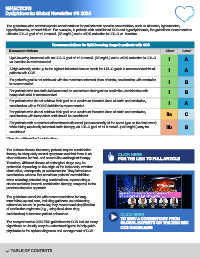
     The guidelines also address special considerations for patients with specific comorbidities, such as diabetes, hypertension,
     hyperlipidaemia, or heart failure. For example, in patients with established CCS and hyperlipidaemia, the guidelines recommend an
     ultimate LDL-C goal of <1.4 mmol/L (55 mg/dL) and a ≥50% reduction in LDL-C vs. baseline.
                                                                                                                   Dyslipidaemia

                                Recommendations for lipid-lowering drugs in patients with CCS

      Recommendations                                                                                 Class a   Level b
      Lipid-lowering treatment with an LDL-C goal of <1.4 mmol/L (55 mg/dL) and a ≥50% reduction in LDL-C   I    A
      vs. baseline is recommended.

      A high-intensity statin up to the highest tolerated dose to reach the LDL-C goals is recommended for all   I  A
      patients with CCS.

      If a patient’s goal is not achieved with the maximum tolerated dose of statin, combination with ezetimibe
      is recommended.                                                                                   I         B

      For patients who are statin-intolerant and do not achieve their goal on ezetimibe, combination with
      bempedoic acid is recommended.                                                                    I         B

      For patients who do not achieve their goal on a maximum tolerated dose of statin and ezetimibe,   I        A
      combination with a PCSK9 inhibitor is recommended.
      For patients who do not achieve their goal on a maximum tolerated dose of statin and ezetimibe,   IIa       C
      combination with bempedoic acid should be considered.
      For patients with a recurrent atherothrombotic event (not necessarily of the same type as the first event)
      while taking maximally tolerated statin therapy, an LDL-C goal of <1.0 mmol/L (<40 mg/dL) may be   IIb      B
      considered.
     a Class of recommendation.  Level of evidence.
                        b

     The authors discuss that many patients require combination
     therapy to adequately control symptoms and that there is no         CLICK HERE
     clear evidence for first- and second-line antianginal therapy.      FOR THE LINK TO FULL ARTICLE
     Therefore, different classes of antianginal drugs may be
     preferable depending on the origin of the ischaemia, whether
     obstructive, vasospastic, or microvascular. They introduce a
     combination scheme that considers patients’ comorbidities
     when selecting potential drug combinations, representing a
     clearer evolution towards combination therapy compared to the
     previous stepwise approach.

     The guidelines conclude with recommendations for long-
     term follow-up and care, including guidance on addressing
     adherence issues. In particular, they recommend simplification
     of medication regimens (e.g., using fixed-dose drug
     combination) to increase patient adherence.                           CLICK HERE
                                                                           TO VIEW A COMMENTARY FROM
     The comprehensive 2024 ESC guidelines for CCS include many            GLOBAL EXPERTS ON THE 2024 ESC
     algorithmic or visually easy-to-understand figures to help guide      CCS GUIDELINES.
     physicians in the optimal diagnosis and management of CCS.


          TABLE OF CONTENTS

